
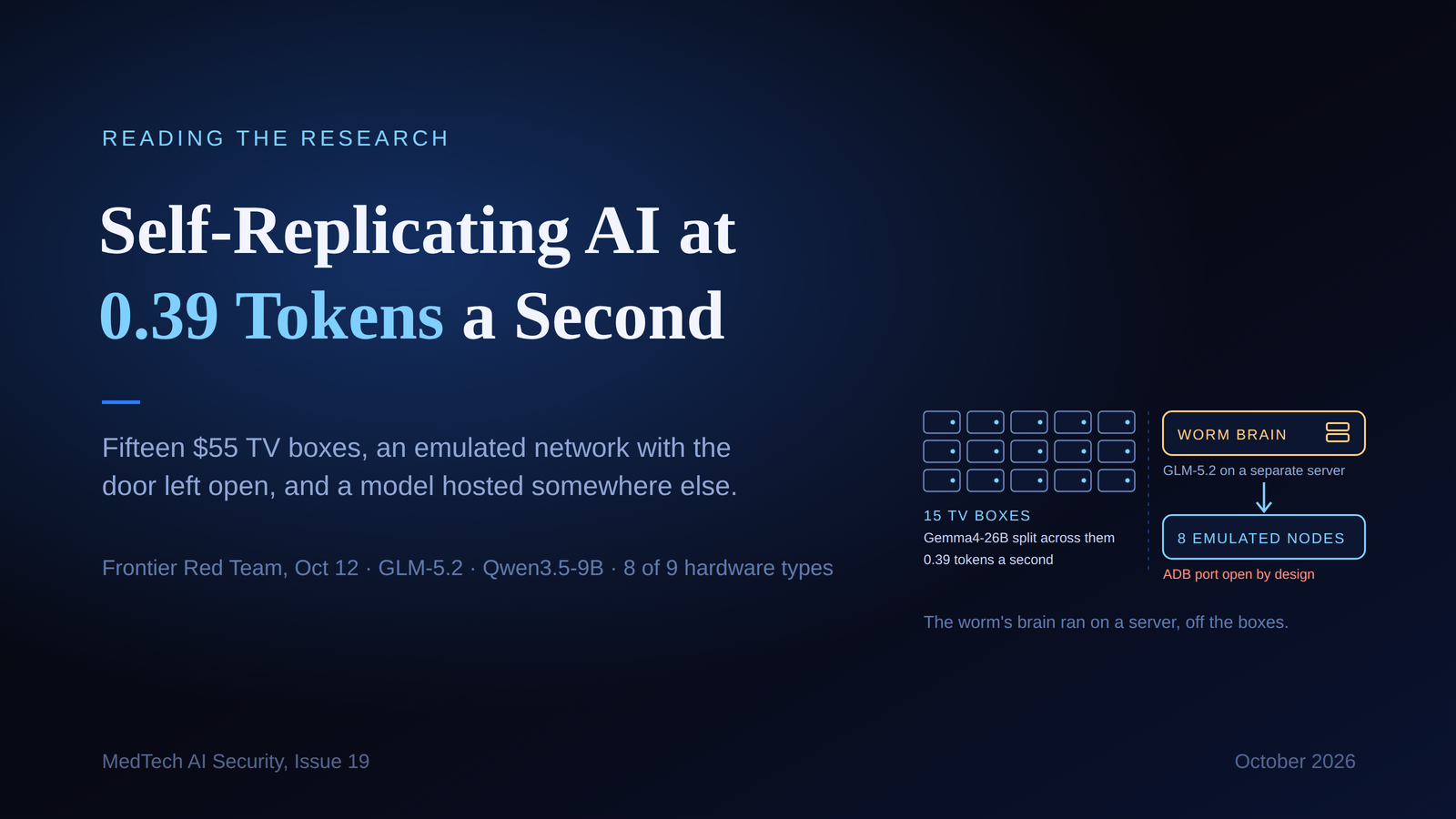
On October 12 Anthropic's Frontier Red Team published a post titled "AI models may be capable of self-replicating without access to a datacenter." The headlines that followed had AI spreading across smart TVs and ovens within months. The experiments inside the post are worth reading on their own terms, because the demonstrations are narrower than the headline.
The headline demo is 15 off-brand Android TV boxes, about $55 each with 4 GB of RAM, running Gemma4-26B-A4B as one model split across all of them. Each box holds a few of the model's layers and passes activations to the next box, the pipeline parallelism the post compares to Petals. The fleet produced 0.39 tokens per second. The post's own throughput estimate, averaged over a 32k context, is about 0.3. A single 32k window takes 27 to 32 hours on the 26B and about 11 hours on a 9B model, and a full inference setup needs two to five windows. The post's figures are 71 to 150 hours for the 26B and 28 to 51 for the 9B.
The replication experiment ran somewhere else. The authors built a firewalled network of eight Google Cloud nodes running redroid, an Android 15 emulator, and left the ADB debug port unauthenticated on purpose. Patient zero scanned the network, pushed a payload over ADB, stood up a Llama3.1-8B inference server on each target, ran a check, and launched a copy of itself there. GLM-5.2, the model making those decisions, ran on a separate inference server because the nodes were too small to hold it. It reached all eight nodes in four of five trials and seven in the fifth. No other open-weight model they tested completed the chain.
Put together, the post shows a slow model on cheap hardware, plus a capable model hosted elsewhere walking through an emulated network that was configured to let it in. The authors say so themselves: the exploit step was kept trivial, and they call the result an upper bound on real-world success. The engineering holds up, and the authors say they do not yet have a full rogue replicator.
Qwen3.5-9B is small enough to run on boards like the ones in the test. It got an inference server running on 8 of the 9 hardware types the team handed it, from Jetson Nanos and Orange Pis to Mac PCs and RTX 4090s. Across six generations of attempts, with each instance leaving notes for the next, its setup success rose from 45% to between 61% and 84%. A frontier model as an advisor gave no significant improvement, which the authors read as small models struggling to ask useful questions.
Hardware diversity has been a quiet defense against botnets, since a classic botnet carried a build per CPU architecture. A replicator that reads the device in front of it and works out how to run on it does not need one. In an ablation where the inference setup was scripted in advance, even a 3B model reached about half the nodes on a 17-node network. So the setup step is the bottleneck, and a human operator could script it in advance for common device types and leave the odd ones to the model.
The authors also fit a capability trend for models of 30B parameters and under, 13.7 points per year on Epoch's capabilities index. It puts a small model at GLM-5.2's level on this task by the end of 2026. The post's "months away" rests on that projection, which covers a small model matching a large one on an eval where the exploit step was made trivial.
A hospital device fleet looks more like this test bench than most people would like. ARM boards, 4 GB of RAM, Android forks and embedded Linux, long service lives, and a patch cadence measured in months. The deliberately open ADB port is the realistic part. ADB.Miner spread a Monero miner across Android devices through an exposed debug bridge on port 5555 in 2018, with no model involved. In the postmarket work I see, exposed debug interfaces and default credentials are still common findings. Anthropic's own read is that real IoT security may not be much harder than its trivial step, based on how Mirai got in.
A replicator's spread rate depends on the exploit step, which the post kept trivial, and on how many new devices each infected one reaches, its R0. The token rate only sets how slowly the thing thinks, and the post's estimate is a doubling time of days. Two million devices, the size of the Kimwolf botnet, would give an attacker about 133,000 model replicas and roughly 80,000 tokens per second in total. The authors put that at about 40 H100s.
Device makers already know the post's defensive notes. Flow monitoring on a segmented clinical network sees the multi-gigabyte weights a replicator has to move from device to device. Honeypots catch a copy. ISP quarantine during the Mirai cleanup cleared 92% of infections within 14 days against 74% with no notification. And the UK made default passwords non-compliant on consumer devices in April 2024, which is the kind of rule that pushes R0 below one before any model gets involved.
I am watching the exploit step more than the token rate. The inference setup result is new, and the replication result was measured on an emulator with authentication turned off, so it is an upper bound. A research demo becomes a worm when someone pairs a small model that can stand up inference on an unfamiliar board with a real path onto the device. For a device maker the path is the part under their control, which in practice means default credentials and debug ports that answer on the clinical network. The same findings have sat on postmarket reports for years, and they set how far a replicator gets.
---
Sources: Anthropic Frontier Red Team (William Zhou, Daniel Freeman), "AI models may be capable of self-replicating without access to a datacenter," October 12, 2026. 360 Netlab, early warning on the ADB.Miner botnet, February 2018. Public reporting on the Kimwolf Android botnet, December 2025 onward (1.8 million devices at first report, later more than 2 million). UK Product Security and Telecommunications Infrastructure regime, in force April 29, 2024.