
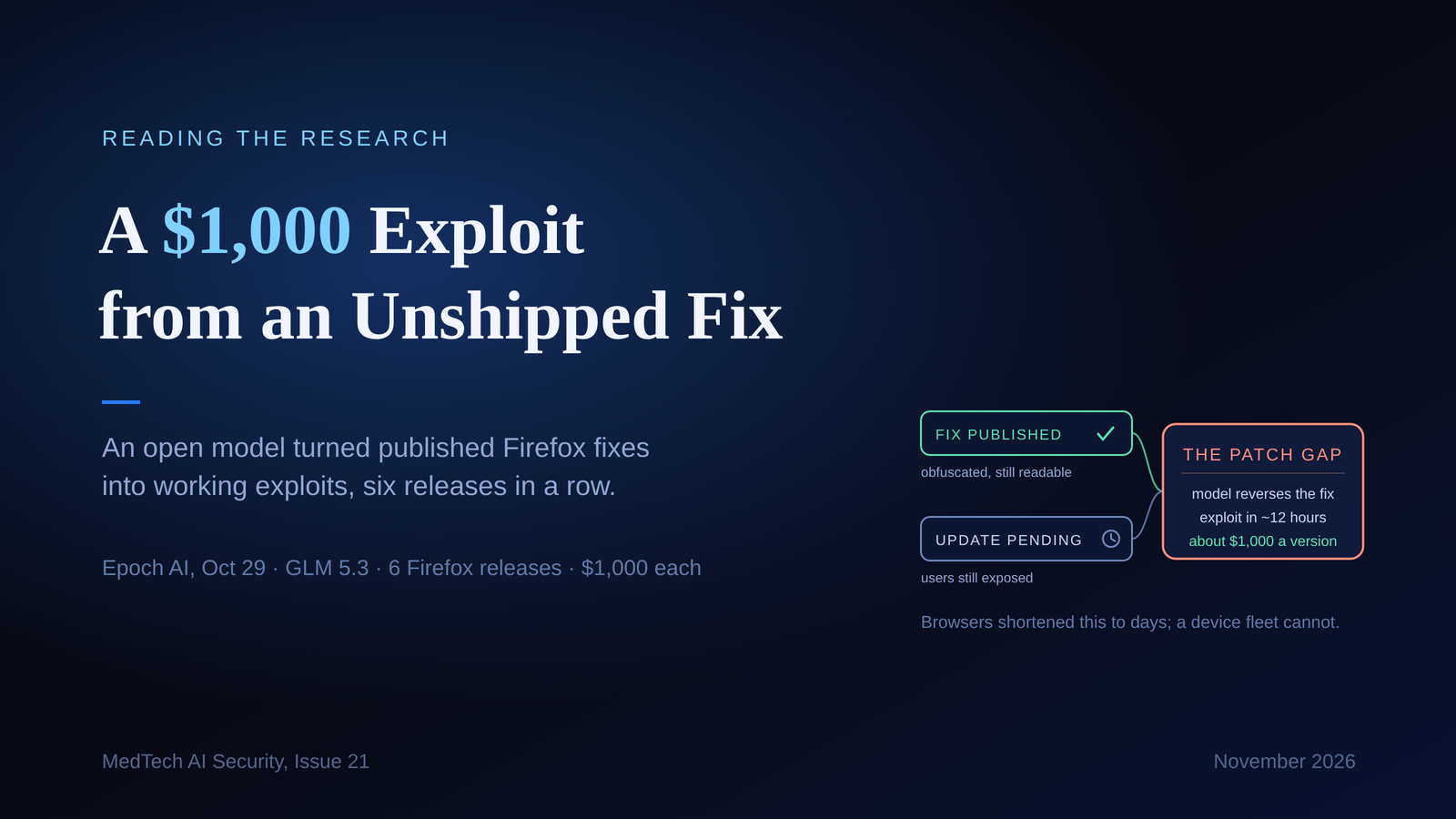
The window between a security fix being published and that fix reaching users now costs about $1,000 to exploit, and the model that does the work is a free download. Epoch AI put a number on it on October 29. GLM 5.3, the open-weight model from Z.ai that Issue 18 covered, built working zero-click exploits for six consecutive Firefox releases using nothing but the fixes Mozilla had published and not yet shipped. Those releases, 156 through 158, went out between September 17 and October 26, and any of them could be taken over by a webpage visit. Firefox has more than 200 million users.
The exploit reads a file off the visitor's machine and sends it to the attacker with no clicks, which is enough to lift saved browser passwords, session cookies, and private documents. GLM 5.3 found the security-relevant changes inside fixes that Mozilla deliberately disguises as routine improvements, picked the vulnerabilities, and assembled the chain on its own with no human input, using only information that was public when each version shipped. It needed between 12 and 48 hours per release. Epoch's total bill ran past $100,000 to build an offline harness and work out the approach, and the marginal cost per Firefox version after that was about $1,000 at API prices. Neither GLM 5.3 nor Z.ai's API refused any of it.
Every successful attack also used one unpublished vulnerability the model rediscovered each time, which Epoch disclosed to Mozilla and Firefox 159.0 patched on October 27. The same harness has not cracked Google Chrome after roughly another $100,000 in attempts, and Epoch treats that as a limit of this setup with no claim that Chrome is safe.
A published fix is a map to the vulnerability it closes, whatever the commit message says. Open-source projects publish that map by design, in the repo and the nightly branches, and the lag before a fix ships to users has been a known weakness for years. What kept it survivable was the cost of reading the map, a skilled researcher's time or access to a gated frontier model, and Epoch puts that cost at about a thousand dollars. Closed-source software gets no exemption either. Anthropic has shown Mythos exploiting the patch gap on Windows with no source available, and Epoch expects open models to follow.
Issue 20 ran on the same clock. When PHP2Shell landed late last month, patched builds and leaked details ran hours ahead of the coordinated advisory, and Cloudflare watched exploit attempts climb from thousands to millions once the gap opened. Epoch shows the reading step is now cheap enough for almost anyone to run. Firefox 159 shows both directions at once: the release that closes Epoch's unpublished bug also fixes 167 issues, 34 of them credited to OpenAI's Codex security work. AI sits on both sides of that single bulletin, finding the bugs and turning the fixes into attacks.
The week also split the open-weight labs. GLM 5.3 shipped with no cyber guardrails and did this on request. Moonshot's Kimi K3.1 Pro, on API since October 23 with weights due November 4, stripped cyber content from its training data and reinforcement environments on purpose. On Moonshot's own exploit benchmark the unmitigated model solved 90.5% of tasks and the released one solves 81%, still well above the prior generation's 33%, so the restraint is real and partial. Moonshot says it will not let open weights push the absolute frontier of cyber capability and will raise that ceiling only gradually.
Neither posture binds anyone else once weights are public. A more permissive model shipping later undoes Moonshot's restraint for everyone, because attackers simply use whichever open model is most capable.
Medical devices live inside the patch gap. A fielded device runs software that was validated and frozen long before the current threat, and a fix moves through verification and regulatory coordination on a cycle measured in months. Every third-party component inside it, the browser engine, the TLS library, the language runtime, the kernel, gets its public fix upstream long before the device maker can ship it downstream. For a hospital device that interval runs to the better part of a year.
Device makers have relied, mostly without saying so, on one assumption: turning a public fix into a working exploit was hard enough that attackers rarely bothered before the window closed. Epoch prices the end of that assumption at about a thousand dollars, against components whose fixes are fully public, on devices that will not see the patch for months. Section 524B asks manufacturers to address postmarket vulnerabilities in a reasonable time, and what counts as reasonable was set when attackers mostly could not build the exploit before the update landed, which is no longer the case.
Epoch's guidance not to ship fixes for several chainable vulnerabilities in one update transfers directly to firmware, because a model that gets the whole bundle gets the chain. Device makers that batch a quarter's postmarket fixes into one validated release are shipping exactly that bundle.
I am watching whether Moonshot's restraint spreads or stays a minority of one. If the next open-weight releases meter cyber capability, the floor rises slowly; a single strong model shipping wide open resets it to wherever that model sits. I am also watching for the first clear case of an open model doing this against an embedded or closed-source target instead of a browser, because that is the step between Epoch's demonstration and a device maker's real exposure. The browsers answered by moving to weekly releases, which shrinks their gap to days. A device fleet cannot ship weekly, so for medtech the gap stays wide while the price of attacking it keeps dropping.
---
Sources: Epoch AI (Aiden Ament, Yafah Edelman, Alexander Barry, Timothée Chauvin, Lee Bousfield, Jaeho Lee), "Open-weight AI models can exploit the patch gap," October 29, 2026. Mozilla Foundation Security Advisory MFSA 2026-118, Firefox 159.0, October 27, 2026 (167 CVEs, 34 credited to OpenAI Codex security). Moonshot AI, Kimi K3.1 Pro release and cyber-capability mitigation notes, October 23 to 25, 2026 (open weights due November 4). PHP2Shell (CVE-2026-109618 and CVE-2026-109619), coordinated disclosure late October 2026, covered in Issue 20. Anthropic on model-driven exploitation of undisclosed vulnerabilities, 2026. GLM 5.3 open-weight model, Z.ai, August 2026, covered in Issue 18.